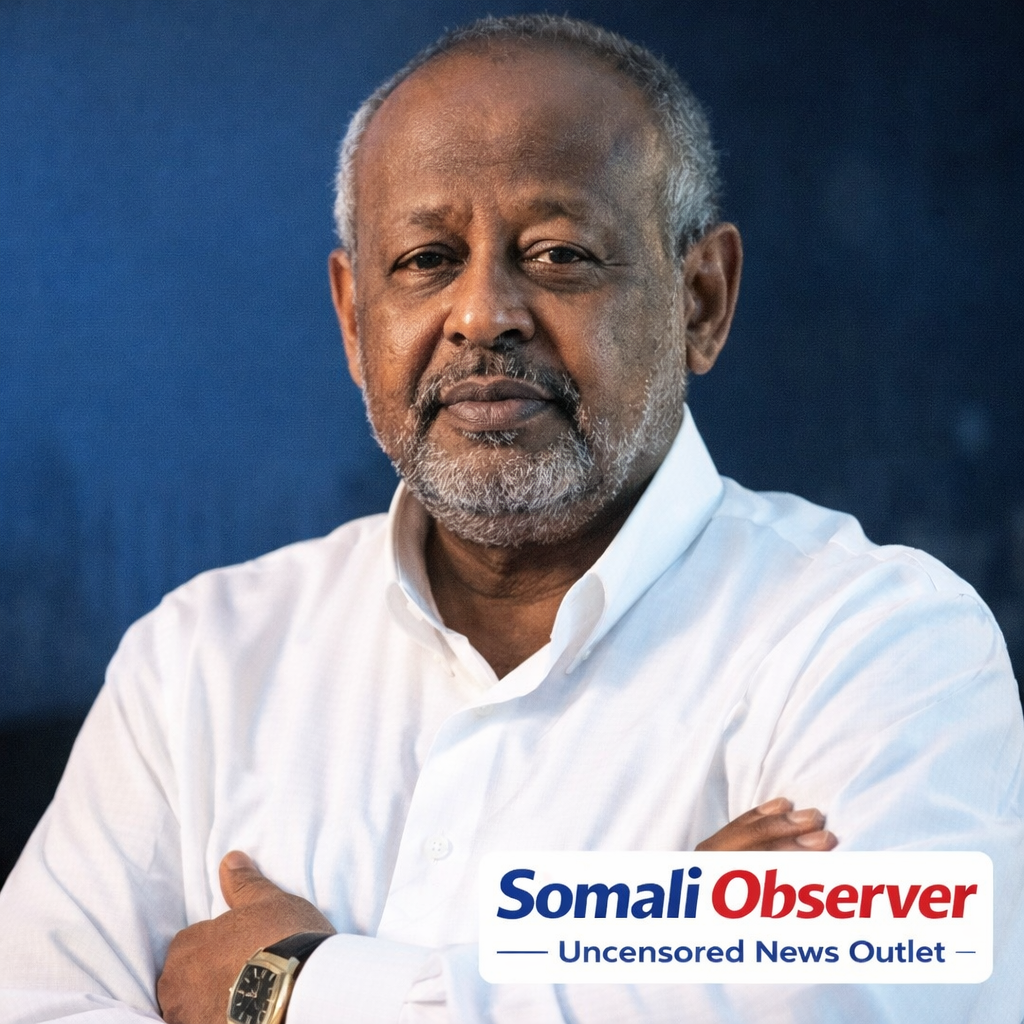
Djibouti City – Djibouti’s President Ismaïl Omar Guelleh has defended his decision to run for a sixth presidential term, citing growing regional instability and national security concerns as key reasons behind his candidacy.
In an exclusive interview published in Jeune Afrique, the 78-year-old leader said the geopolitical environment in the Horn of Africa has become increasingly volatile, arguing that continuity in leadership is necessary to safeguard Djibouti’s sovereignty and stability.
Guelleh acknowledged that constitutional changes removing the presidential age limit enabled his candidacy but insisted the decision was driven by public demand for stability during uncertain times.
Focus on National Identity and Stability
The president emphasised strengthening “Djiboutian identity” as a central priority, describing it as a unifying civic concept that transcends ethnic divisions. He highlighted the importance of national cohesion in a region marked by political tensions and external rivalries.
Djibouti, home to approximately 1.2 million people, currently hosts around 300,000 migrants. While reaffirming the country’s humanitarian approach, Guelleh warned that immigration must be carefully managed to preserve national unity.
Economic Ambitions and Green Transformation
Guelleh outlined ambitious economic plans, including the development of a green industrial park aimed at transforming Djibouti from a logistics hub into a competitive, export-oriented green economy.
The project seeks over $8 billion in investment, with projections of increasing GDP to $10 billion and raising per capita income from $4,000 to $10,000. The initiative would rely entirely on renewable energy, including wind and solar power, to produce green hydrogen, ammonia, and industrial materials.
Despite criticism from international institutions regarding inequality, the president pointed to expanded social assistance programs, universal health coverage, and improved vaccination rates as evidence of inclusive growth.
Strong Position on Somaliland and Israel
Guelleh strongly criticized Israel’s recognition of Somaliland, warning that the move could destabilize the region. He expressed concern over potential military developments in Berbera and accused the United Arab Emirates of playing a key role in facilitating Israel’s involvement.
Relations between Djibouti and Somaliland remain tense, with diplomatic communication reportedly limited.
Security and International Relations
On regional security, Guelleh criticized U.S. military strikes in Somalia for what he described as insufficient coordination with neighboring countries. He stressed the importance of consultation and regional cooperation in combating extremist threats.
He also reaffirmed Djibouti’s strategic partnership with France under a new military cooperation agreement and confirmed that a new international airport, partly supported by French financing, is expected to be operational by 2029.
Looking Ahead
As Djibouti approaches the 50th anniversary of its independence in 2027, Guelleh said the country has successfully preserved its sovereignty and avoided ethnic conflict since 1977. He maintained that continuity in leadership remains essential to navigating regional challenges and ensuring long-term stability.